Encourage One Another Day After Day: A Reflection on Hebrews 3

I’ve lately been contemplating the purchase of a new Bible. I’m a believer in marking one’s Bible, but I suspect that such highlights, underlines, etc. can inadvertently lead to neglecting portions of our Bibles as our eyes are drawn naturally to our annotations. I suppose a fresh copy will lead to a fresh reading.

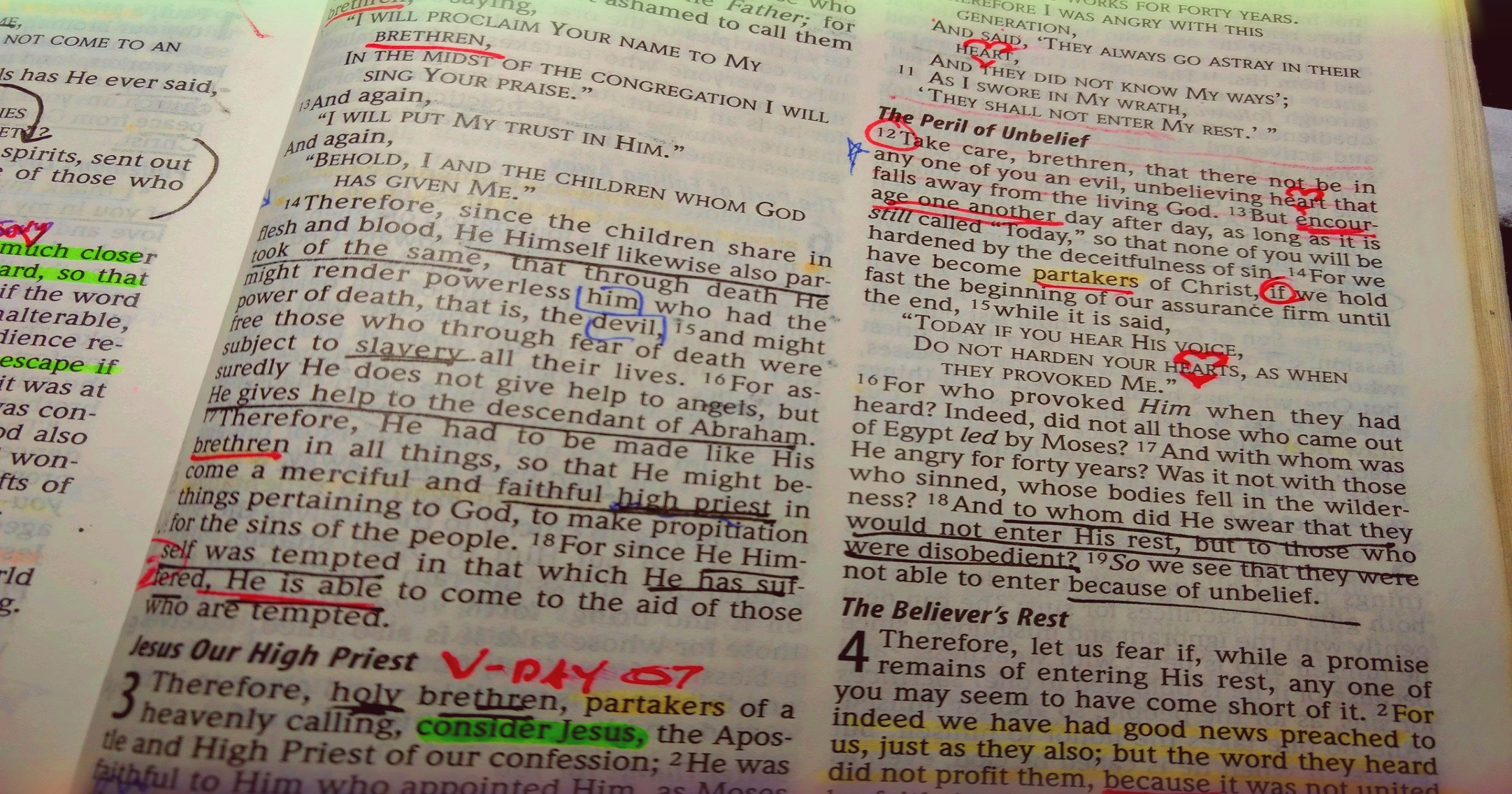
Thinking to buy a Bible I’ve previously used, I grabbed the one I had in Bible college to “test drive” the format. I started reading Hebrews. Apparently, we worked through Hebrews 3 on Valentine’s Day 2007. I wrote “V-DAY 07” next to the heading. The record shows I drew red hearts around all the instances where the word heart appears also. This Bible is very marked up, and this morning it led to the following observations and reflections:

(So that I might dive straight in, take a moment to read Hebrews 3, in your Bible or here. It will take two minutes.)

Did you notice what is said concerning the heart?

v.8 – Do not harden your hearts

v.10 – They always go astray in their heart

v.12 – …unbelieving heart that falls away

v.15 – Do not harden your hearts

With this in view, return to verse 13, which says, “But encourage one another day after day…” Why? Because of how easy it is for this – verses 8, 10, 12, 15 – to happen! Specifically, the author says, “so that none of you will be hardened by the deceitfulness of sin.” This is the danger. And it is a danger for Christians. I think we know this intuitively, but there are clues in the text also, including the author’s repeated address of “brethren” (verses 1, 12). There are more clues, but perhaps the most sobering is the repeated references to the Exodus, the analogy of our own redemption. Not only were the Israelites brought out of the land of slavery by God, they clearly saw the miraculous ways in which He worked to accomplish their salvation. And yet, their hearts were hardened – i.e., they hardened their own hearts, little by little, day by day, by unbelief. If you are saved, I do not think you can lose your salvation, but I do think we can, through unbelief and its many manifestations, become hard-hearted. I’ve seen it. I’ve experienced it. But a hard heart can just as well be indicative of an unsaved heart. If that be the case, flee to Christ Jesus! And if, Christian, your heart is hard or cool, flee to Christ Jesus!

He is the Faithful One. He is our Rest. Consider Jesus, you holy partakers of Him and His heavenly calling. Keep your eyes fixed on Him, the foundation of our faith. And encourage one another day after day so that our hearts will not grow hard, but remain soft and sensitive to the things of God, submitted to Him in all things, in joy-filled service and worship.
Excerpts: From J. Edwards’s Religious Affections

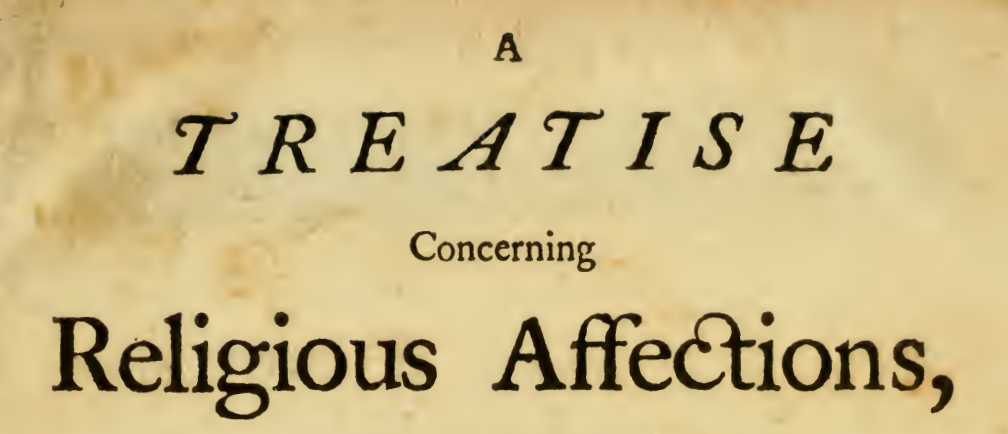
From the title page, Public Domain

I am presently reading a Jonathan Edwards Reader for a class. It’s been fantastic, with plenty of worthy portions to excerpt (well, that goes without saying). But one particular portion really jumped out at me, and that is what follows below. It is found in Part 3, Section 12 of the Affections; Part 3 being about the “distinguishing signs of truly gracious and holy affections,” and Section 12 detailing how “gracious and holy affections have their exercise and fruit in Christian practice.”

(For a helpful overview of the whole of Edwards’s Religious Affections, see this article by Justin Taylor at TGC. The text in its entirety can be found here.)

Edwards:

I proceed to show, that Christian practice, taken in the sense that has been explained, is the chief of all the evidences of a saving sincerity in religion, to the consciences of the professors of it; much to be preferred to the method of the first convictions, enlightenings, and comforts in conversion, or any immanent discoveries or exercises of grace whatsoever, that begin and end in contemplation. The evidence of this appears by the following arguments.

ARGUMENT I.—Reason plainly shows, that those things which put it to the proof what men will actually cleave to and prefer in their practice, when left to follow their own choice and inclinations, are the proper trial what they do really prefer in their hearts. Sincerity in religion, as has been observed already, consists in setting God highest in the heart, in choosing him before other things, in having a heart to sell all for Christ, &c. But a man’s actions are the proper trial what a man’s heart prefers. As for instance, when it is so that God and other things come to stand in competition, God is as it were set before a man on one hand, and his worldly interest or pleasure on the other (as it often is so in the course of a man’s life); his behavior in such case, in actually cleaving to the one and forsaking the other, is the proper trial which he prefers.

Sincerity consists in forsaking all for Christ in heart; but to forsake all for Christ in heart, is the very same thing as to have a heart to forsake all for Christ; but certainly the proper trial whether a man has a heart to forsake all for Christ is his being actually put to it, the having Christ and other things coming in competition, that he must actually or practically cleave to one and forsake the other. To forsake all for Christ in heart, is the same thing as to have a heart to forsake all for Christ when called to it: but the highest proof to ourselves and others, that we have a heart to forsake all for Christ when called to it, is actually doing it when called to it, or so far as called to it.

To follow Christ in heart is to have a heart to follow him. To deny ourselves in heart for Christ, is the same thing as to have a heart to deny ourselves for him in fact. The main and most proper proof of a man’s having a heart to any thing, concerning which he is at liberty to follow his own inclinations, and either to do or not to do as he pleases, is his doing of it. When a man is at liberty whether to speak or keep silence, the most proper evidence of his having a heart to speak, is his speaking. When a man is at liberty whether to walk or sit still, the proper proof of his having a heart to walk, is his walking. Godliness consists not in a heart to intend to do the will of God, but in a heart to do it.

Note: I added the two breaks above in the Arg. 1 paragraph for ease of reading. The bold sentences are mine as well.

Book Review: Turnaround by Jason Allen

In the fall, I had the privilege of attending a leadership talk by Dr. Allen. I took many notes, even after learning that much of what he was saying would also be found in his then forthcoming book Turnaround. As a history student at MBTS, I was especially excited to hear that Turnaround would contain the story of MBTS. I was eager to get my hands on it, and I was already thinking of who I might gift it to. There are a number of reasons I chose MBTS, but the majority of those attractions were the product of priorities cultivated under Dr. Allen’s leadership (and certainly God’s blessing), the composition of which is well captured in this book.

Dr. Allen begins by stating, “I believe most everything you’ve learned about leadership is incorrect” (1, Introduction). Although most of the chapter topics are not particularly novel, how he handles those topics is unique – in terms of explanation, illustration, and application, but also in terms of how they relate to one another. In short, there is a strong sense of renewal and integration about his approach, which can also be seen in his noted themes of faithfulness, providence, credibility, and teamwork. Though unstated, another evident theme is his pastoral heart.

Here is an overview of the book, chapter by chapter. It is by no means comprehensive, but nevertheless captures some of the key ideas, or things that stood out to me.

(1) Context: Know who you’re leading, yourself, your EQ, your family, your team, and your constituency.

(2) Convictions: Reject ambiguity; know and embrace the importance of safeguarding confessionalism and living it out in and for your context.

(3) Mission: It’s crucial for surviving and thriving; not only does Dr. Allen state this, but he also gives the why.

Continue reading “Book Review: Turnaround by Jason Allen”

Joshua Harris is not the problem. (We are.)

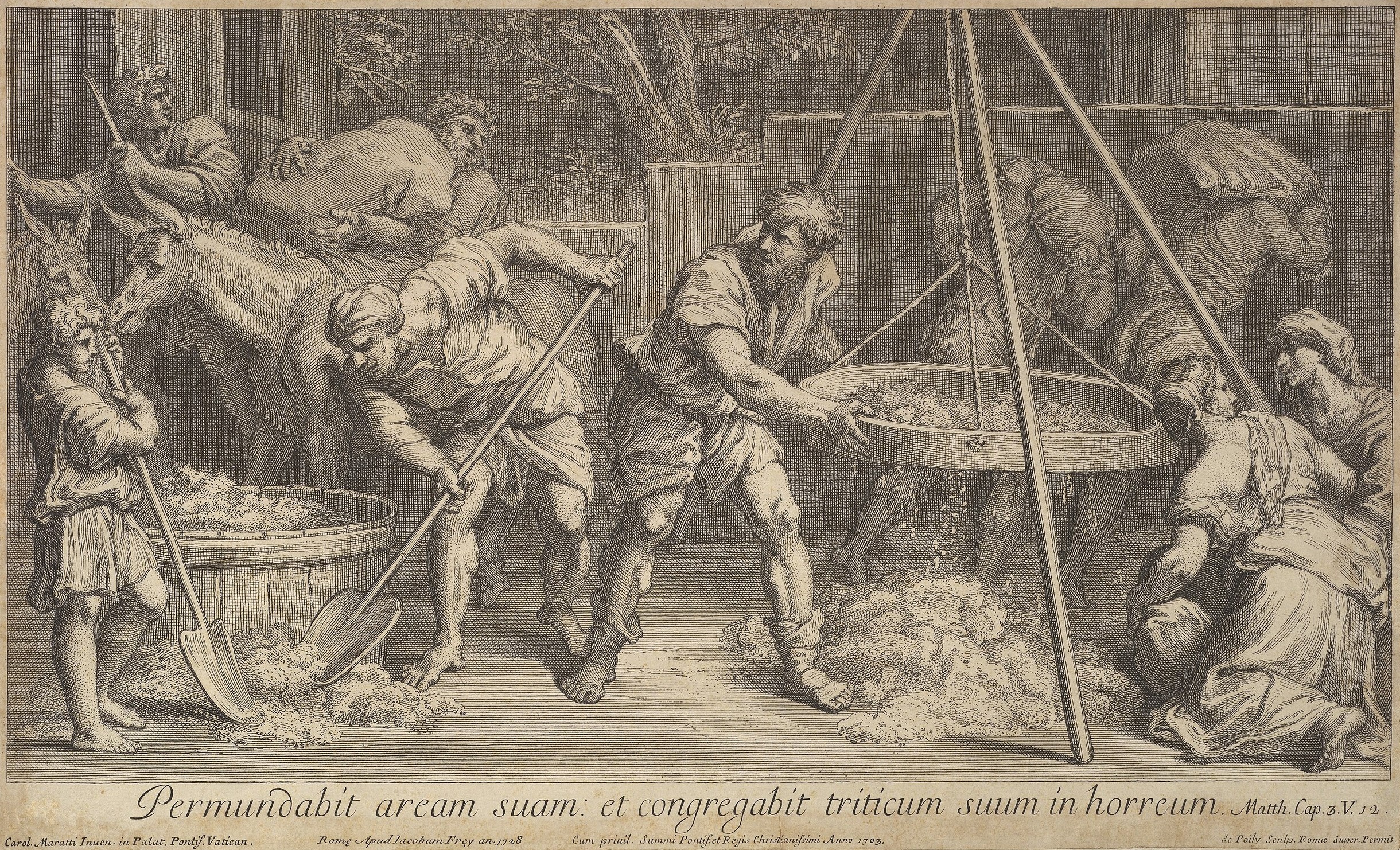
The Wheat & The Chaff, Public domain, via Wikimedia Commons

A couple of weeks ago, WORLD published an Opinion piece entitled “Why we need a Joshua Harris rule: How about a moratorium on Christian self-help books from authors under age 40?”

You can read it here, but the title just might say it all.

Importantly, the authors recognize a real problem. And they offer a solution.

Unfortunately, both are grossly oversimplified:

The problem – by locating it primarily with the influencer, with little reference to the responsibility of the influenced.

And the solution – by advocating the removal of the influencer rather than the adjudication of truth, a classic case of throwing the baby out with the bath water.

Part 1: Joshua Harris is not the problem. (We are.)

My candid contention is this: Joshua Harris is not the problem. We are. We don’t need a Joshua Harris rule. We need Jesus, His Word, and to be more discerning about all manner of Christian media.

Put bluntly, we have a propensity to make gods out of people and scripture out of their books and, in the worst cases, crucify them when they don’t turn out to be Jesus and their books the Words of life.

Continue reading “Joshua Harris is not the problem. (We are.)”

Rainbow Reminders

Grand Canyon National Park, Public domain, via Wikimedia Commons

The story of Noah and the flood is well known – God observes humanity’s sin; God decides to destroy humanity, except for Noah; God instructs Noah to build the ark, etc. (See Genesis 6-9 for the full story.)

For the purposes of this post, I want to fast-forward to the end – Genesis 9. There, God covenants with Noah, his family, and all the creatures of the earth, saying, “Never again will all life be destroyed by the waters of a flood” (v.11, NIV). God then says, “This is the sign of the covenant… my rainbow in the clouds” (vv.12-13).

All of this is very familiar. And like so many familiar stories, it is easy to miss peculiarities like the fact that God says twice, “When I see the rainbow, I will remember my covenant” (my paraphrase, cf. vv.15-16).

God will remember? Well, that’s interesting, considering God is omniscient. Even more interesting that He twice frames the rainbow as for His remembrance and not ours. That is what struck me a couple of weeks ago as I prepared to lead a small group through this chapter.

God doesn’t need the reminder – we do! Over and over and over again. We need the reminders of who we are and who God is and how good He’s been to us when we don’t deserve it.

Not only that, but I think there’s another important lesson here to be taken to heart; namely, setting signs to remind us of truth – of who we are and who God is and how good He’s been to us when we don’t deserve it. Because those are the things we need to be reminded of, over and over and over again.

Jonathan Edwards Portions: His Resolutions and Ours

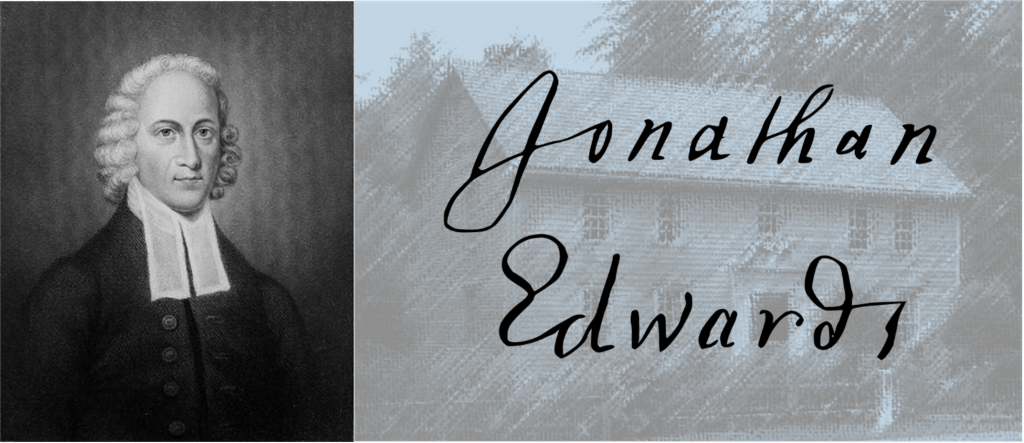
Jonathan Edwards engraving, Stockbridge mission house, Edwards’s signature

I couldn’t help but laugh. I had come upstairs for lunch, announced by my 3-year-old daughter a moment before: “Lunch is ready!” But what I found hilarious was my wife’s comment: “I don’t know if this is a Gwennie portion or a Jonathan Edwards portion.” On my plate lay a couple of fish fillets and five broccoli florets. Gwennie portions were smaller portions, which had become something of a running joke. But Jonathan Edwards portions?

Continue reading “Jonathan Edwards Portions: His Resolutions and Ours”

God Wants to Blow God Up

This past spring, about a week after last posting to the blog, I was taking notes on a sermon I heard preached at the 2016 Linger Conference in Dallas: Pastor Eric Mason’s exposition of Psalm 23. About 30 minutes in, I heard a part that immediately made me think of John 3:30: “He must increase, but I must decrease.”


But let’s start with the beginning of the old, familiar Psalm.

The Lord is my shepherd,
I shall not want.
He makes me lie down in green pastures;
He leads me beside quiet waters.
He restores my soul;
He guides me in the paths of righteousness
For His name’s sake.[1]

For His name’s sake. Continue reading “God Wants to Blow God Up”

…but I must decrease (J. C. Ryle on Pride)

Earlier this year I was reading J. C. Ryle’s Thoughts for Young Men. I stumbled across this brief text (about 100 pages) in a “Top 20 of 2020” list from Banner of Truth (one of my favorite publishers) – and I’m sure glad I did, for I found it a hard hitting and highly motivating book.

J. I. Packer described Ryle as “a single-minded Christian communicator of profound biblical, theological, and practical wisdom, a man and minister of giant personal stature and electric force of utterance that sympathetic readers still feel.”

Regarding this book in particular, one young reviewer wrote, “I can just say I wish I had this book at the age of 15.” Me too, friend, me too. Continue reading “…but I must decrease (J. C. Ryle on Pride)”

ἐκεῖνον δεῖ αὐξάνειν ἐμὲ δὲ ἐλαττοῦσθαι

“He must increase, but I must decrease.”

There is a story in the third chapter of the book of John where John’s (i.e., John the Baptist, not the Apostle who authored the book) disciples reported to him that the crowds that once flocked to John (cf. Matt 3:5) were now flocking to Jesus (cf. John 3:26). John’s response?

“A man can receive nothing unless it has been given him from heaven. You yourselves are my witnesses that I said, ‘I am not the Christ,’ but, ‘I have been sent ahead of Him.’ He who has the bride is the bridegroom; but the friend of the bridegroom, who stands and hears him, rejoices greatly because of the bridegroom’s voice. So this joy of mine has been made full. He must increase, but I must decrease.”

He must increase, but I must decrease.

Continue reading “ἐκεῖνον δεῖ αὐξάνειν ἐμὲ δὲ ἐλαττοῦσθαι”